

“Shall I bend low and in a bondman’s key,
With bated breath and whisp’ring humbleness…?”Shylock (Merchant of Venice, Act 1, Scene 3)
As dark nights draw in, the venerable contrarians at the GWPF are still up late commissioning silly pseudo-rebuttals to mainstream science. The latest, which no-one was awaiting with any kind of breath, is by Dr. Ray Bates (rtd.) which purports to be a take-down of the recent #SR15 report. As Peter Thorne (an IPCC author) correctly noted, this report is a “cut-and-paste of long-debunked arguments”. I’ve grown a little weary of diving down to rebut every repetitive piece of nonsense, but this one has a few funny aspects that make it worthwhile to do so.
When they go low, we go “sigh…”.
Peter wrote a short rebuttal himself and notes a remarkable display of chutzpah by Bates. Bates quotes a line from the AR5 SPM:
It is extremely likely that more than half of the observed increase in global average surface temperature from 1951 to 2010 was caused by the anthropogenic increase in greenhouse gas concentrations and other anthropogenic forcings together.
And then states “This statement did not necessarily attribute all the observed post-1950 warming to anthropogenic effects”. This is of course true. You actually need to read the next line for that:
The best estimate of the human-induced contribution to warming is similar to the observed warming over this period.
But instead of noting that (or the substantive discussion in Chapter 10 that supported it), he claims that
In contrast to this caution, SR1.5 portrays all the global warming observed since the late 19th century as being human-induced (see Figure 1). This major departure from the Fifth Assessment is presented without any rigorous justification.
This is categorically, absolutely, and totally, untrue. The starting point for SR15 is actually exactly what was in AR5 together with more recent literature. Now, this is not the first time that someone has apparently “misunderstood” these lines. I had a substantial back and forth about them with Judith Curry a few years back (see here, and here). [Unsurprisingly perhaps, she thinks Bates’ report is an “excellent analysis“].
It gets better (and by that I mean worse). Bates then comments on Figure SPM1 of the SR15 and says:
The agreement shown in the figure between the observations (with interannual variations smoothed out) and the mean of the climate simulations (produced by global climate models; GCMs) is close, suggesting that strong confidence can be placed in both the indicated acceleration of the warming and its modelled anthropogenic origin.
… except that, this isn’t what is shown in Fig SPM1 at all. Instead, alongside the observations is an estimate of the attributable warming to anthropogenic effects from Haustein et al. (2017), which is not the ‘mean of GCM simulations’ in any respect.
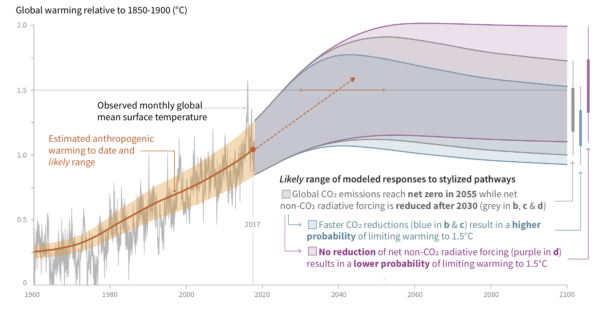
It gets even better. Later in Bates’ article, he is quite enamored by the climate sensitivity results of Lewis and Curry (2018) but doesn’t seem to realise that their results assume that all of the trends since the 19th Century are forced. The exact conclusion he rails against in the first section!
The other paper he likes for it’s climate sensitivity work is his own somewhat obscure effort (Bates, 2016), which argues for an ECS near 1K, despite the clear evidence that the planet has already warmed up by that, with a net forcing substantially less than 2xCO2, and with an ongoing energy imbalance (as evidenced by observed increases in Ocean Heat Content). This, to be gentle, is pretty much impossible.

Unsurprisingly, this isn’t the estimate of OHC that he mentions. He instead pulls another sleight of hand by referencing a result from Laloyaux P., et al. (2018). This is a paper presenting a new (and impressive) coupled data assimilation scheme from ECMWF, but Bates grossly misrepresents the results. The figure he shows is first panel from their figure 10:
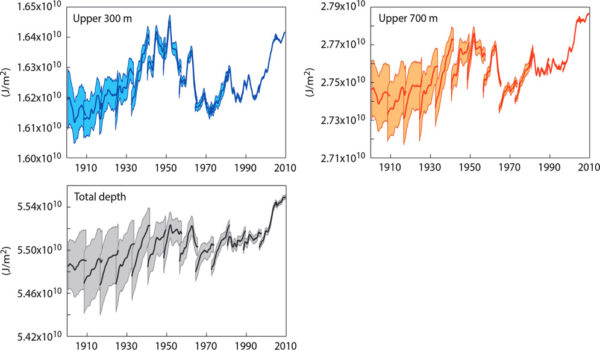
He uses this to claim that “the natural variability of the global SST is greater than had previously been estimated”, when a) this doesn’t show SST (though it is related), b) much of the variance pre-1980 is unphysical model drift, and c) the increases in the full depth OHC actually match direct observational estimated (which is unsurprising since this is a data assimilation exercise).
The rest of the report goes from the sublime (just kidding) to the ridiculous (e.g. using a paper by Nicola Scafetta as an authoritative (!) source – anyone heard of autocorrelation or over-fitting?) and cherry picking the few datasets that minimise current changes. He cut-and-pastes a figure from John Christy that we have oft criticised before. He misreads the climate model tuning paper by Hourdin et al (2017) to claim that all CMIP5 models tuned their results to match the 20th Century trends [Narrator: they did not]. But even if it actually were true, it still wouldn’t impact the results in the first figure he attacks because that doesn’t show the CMIP5 models at all. He appears to be unaware of this.
Overall, this is basically a dialed-in work-for-hire. It’s incoherent, inconsistent, a little bit funny and adds nothing to our understanding of the science behind the SR15 report, or indeed any aspect of the attribution issue.
Since I started with a Shakespearean quote, I’ll finish with another one that is more apropos:
It is a tale
Told by an idiot, full of sound and fury,
Signifying nothing.Macbeth, Act 5 Scene 5
References
K. Haustein, M.R. Allen, P.M. Forster, F.E.L. Otto, D.M. Mitchell, H.D. Matthews, and D.J. Frame, “A real-time Global Warming Index”, Scientific Reports, vol. 7, 2017. http://dx.doi.org/10.1038/s41598-017-14828-5
N. Lewis, and J. Curry, “The Impact of Recent Forcing and Ocean Heat Uptake Data on Estimates of Climate Sensitivity”, Journal of Climate, vol. 31, pp. 6051-6071, 2018. http://dx.doi.org/10.1175/JCLI-D-17-0667.1
J.R. Bates, “Estimating climate sensitivity using two-zone energy balance models”, Earth and Space Science, vol. 3, pp. 207-225, 2016. http://dx.doi.org/10.1002/2015EA000154
P. Laloyaux, E. de Boisseson, M. Balmaseda, J. Bidlot, S. Broennimann, R. Buizza, P. Dalhgren, D. Dee, L. Haimberger, H. Hersbach, Y. Kosaka, M. Martin, P. Poli, N. Rayner, E. Rustemeier, and D. Schepers, “CERA-20C: A Coupled Reanalysis of the Twentieth Century”, Journal of Advances in Modeling Earth Systems, vol. 10, pp. 1172-1195, 2018. http://dx.doi.org/10.1029/2018MS001273
F. Hourdin, T. Mauritsen, A. Gettelman, J. Golaz, V. Balaji, Q. Duan, D. Folini, D. Ji, D. Klocke, Y. Qian, F. Rauser, C. Rio, L. Tomassini, M. Watanabe, and D. Williamson, “The Art and Science of Climate Model Tuning”, Bulletin of the American Meteorological Society, vol. 98, pp. 589-602, 2017. http://dx.doi.org/10.1175/BAMS-D-15-00135.1
