
Guest post by Matteo Willeit, Potsdam Institute for Climate Impact Research
A new study published in Science Advances shows that the main features of natural climate variability over the last 3 million years can be reproduced with an efficient model of the Earth system.
The
Quaternary is the most recent geological Period, covering the past ~2.6 million
years. It is defined by the presence of glacial-interglacial cycles associated
with the cyclic growth and decay of continental ice sheets in the Northern
Hemisphere. Climate variations
during the Quaternary are best seen in oxygen isotopes measured in deep-sea sediment cores, which represent variations in global ice
volume and ocean temperature. These data show clearly that there has been a general trend towards
larger ice sheets and cooler temperatures over the last 3 million years,
accompanied by an increase in the amplitude of glacial-interglacial variations
and a transition from mostly symmetry cycles with a periodicity of 40,000 years
to strongly asymmetric 100,000-year cycles at around 1 million years ago. However, the ultimate causes of these
transitions in glacial cycle dynamics remain debated.
Among
others, the role of CO2 changes in shaping Quaternary climate dynamics is not
yet fully understood, largely because of the poor observational constraints on
atmospheric CO2 concentrations for the time before 800,000 years BP, beyond the
period covered by high-quality ice core data.
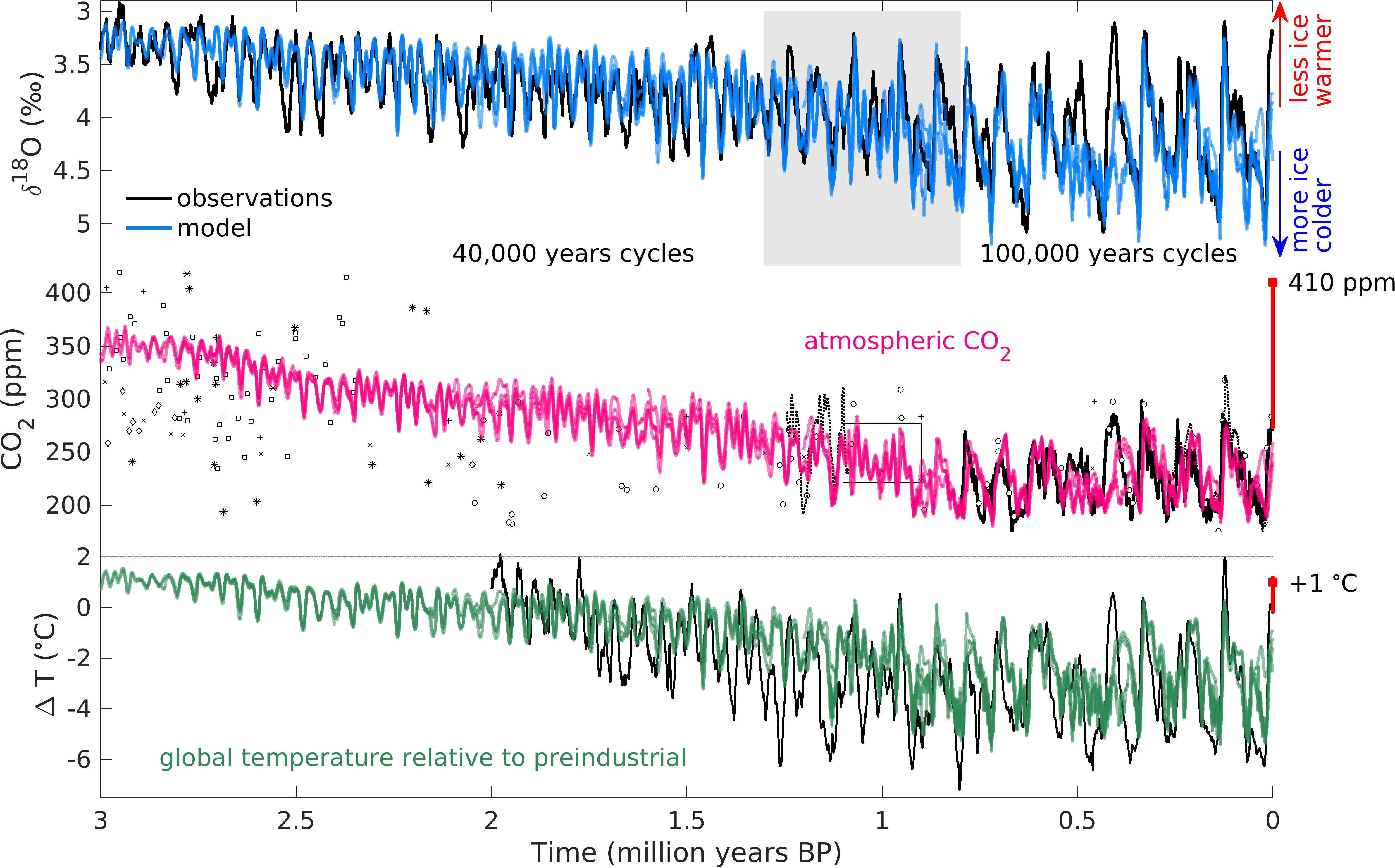
In a paper published today in Science Advances (Williet et al., 2019), we were able to reproduce the natural climate variability of the whole Quaternary with an Earth system model of intermediate complexity. Besides ocean and atmosphere, the model includes interactive ice sheets for the Northern Hemisphere and a fully coupled global carbon cycle and was driven only by changes in orbital configuration and different scenarios for slowly varying boundary conditions, namely CO2 outgassing from volcanoes as a geologic source of CO2, and changes in sediment distribution over the continents.
The model simulations provide a self-consistent reconstruction of CO2, climate and ice sheets constrained by available observations, i.e. oxygen isotopes and reconstructions of sea surface temperature. The fact that the model can reproduce the main features of the observed climate history gives us confidence in our general understanding of how the climate system works and provides some constraints on the contribution of external forcings and internal feedbacks to climate variability.
Our results imply a strong sensitivity of the Earth system to relatively small variations in atmospheric CO2. A gradual decrease of CO2 to values below ~350 ppm led to the start of continental ice sheet growth over Greenland and more generally over the NH at the end of the Pliocene, beginning of Pleistocene. Subsequently, the waxing and waning of the ice sheets acted to gradually remove the thick layer of unconsolidated sediments that had been formed previously over continents by the undisturbed action of weathering over millions of years. The erosion of this sediment layer – it was essentially bulldozed away by moving glaciers – affected the evolution of glacial cycles in several ways. First, ice sheets sitting on soft sediments are generally more mobile than ice sheets grounded on hard bedrock, because ice slides more easily over sediments compared to bedrock. Additionally, glacial sediment transport to the ice sheet margins generates substantial amounts of dust that, once deposited on the ice sheet surface, increases melting of the ice sheets by lowering surface albedo. Our results show that the gradual increase in the area of exposed bedrock over time led to more stable ice sheets which were less responsive to orbital forcing and ultimately paved the way for the transition to 100,000 years cycles at around 1 million years ago.
The simulations further suggest that global temperature never exceeded the preindustrial value by more than 2°C during the Quaternary. Ice sheet evolution is very sensitive to temperature, and the initiation of NH glaciation at around 3 million years ago would not have been possible in the model if global temperature would have been higher than 2°C relative to preindustrial during the early Quaternary. Since the model has been shown to accurately reproduce the sea level variations over the last 400,000 years and also the spatial ice sheet distribution at the last glacial maximum (Ganopolski & Brovkin 2017), we are confident that the sensitivity of ice sheets to climate is well represented in the model.
Likewise, our results indicate that the current CO2 concentration of ~410 ppm is unprecedented over the past 3 million years. The climate sensitivity of the model is around 3°C global warming for a doubling of CO2 concentration, which is at the center of the range of current best estimates of climate sensitivity that range between 1.5 and 4.5°C. It is possible that the real climate sensitivity is lower than 3°C, in which case the modelled CO2 concentration needed to fit the oxygen isotope record during the early Quaternary would be higher than in the present model simulations, but it would still be unlikely to exceed the present day value. In the context of future climate change, our results imply that a failure to significantly reduce CO2 emissions to comply with the Paris Agreement target of limiting global warming well below 2°C will not only bring Earth’s climate away from Holocene-like conditions, but also push it beyond climatic conditions experienced during the entire current geological period.
References
A. Ganopolski, and V. Brovkin, “Simulation of climate, ice sheets and CO<sub>2</sub> evolution during the last four glacial cycles with an Earth system model of intermediate complexity”, Climate of the Past, vol. 13, pp. 1695-1716, 2017. http://dx.doi.org/10.5194/cp-13-1695-2017
